This section supplements the “LIS-SV”
product manual. The parameters described here are only available if the LIS-SV
is used in an ABULiner control unit.
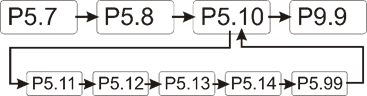
Overview of the
'ABULiner' parameter level
The following parameters can be set in the 'ABULiner'
parameter level of the LIS-SV.
|

|
Danger during setting work!
During setting work on the LIS-SV, monitoring of
the wire rope hoist is switched off. This means the wire rope hoist cannot
be monitored for excess load, among other things. This means the
wire rope hoist cannot be monitored for excess load, among other
things.
This in turn means the load could fall and kill or
injure people!
Do not use the crane for normal work during
setting work, and only lift loads very carefully for test
purposes! |
All LIS-SV parameters which are important for the ABULiner
are combined in a separate parameter level, which is shown as a submenu.
 Move the load hook out of
the limit switch range (up or down).
Move the load hook out of
the limit switch range (up or down).
During parameter setting, the load hook must not be within the
limit switch range.
Open the menu of the
LIS-SV. See the documentation “Load indicator system LIS-SV”.
|
|
|
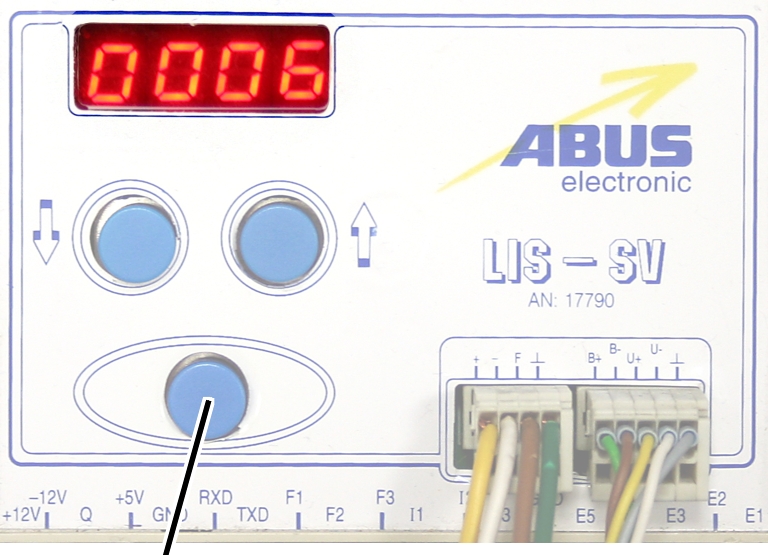
Enter
button |
Arrow
buttons |
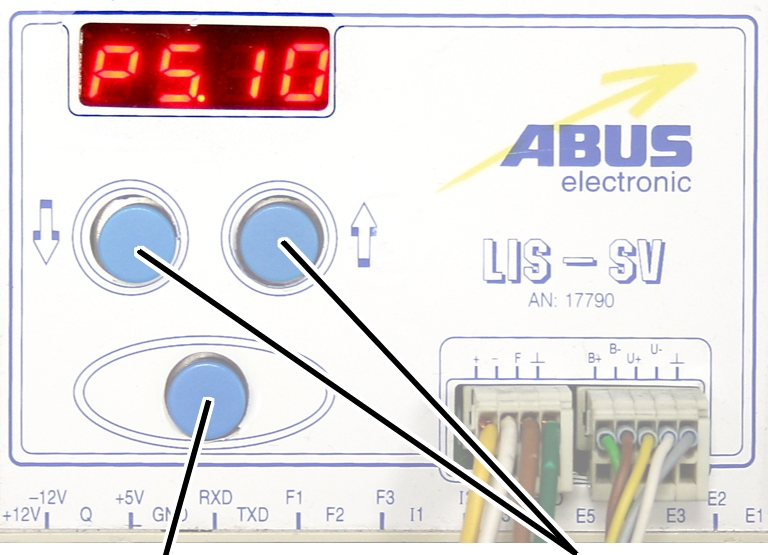
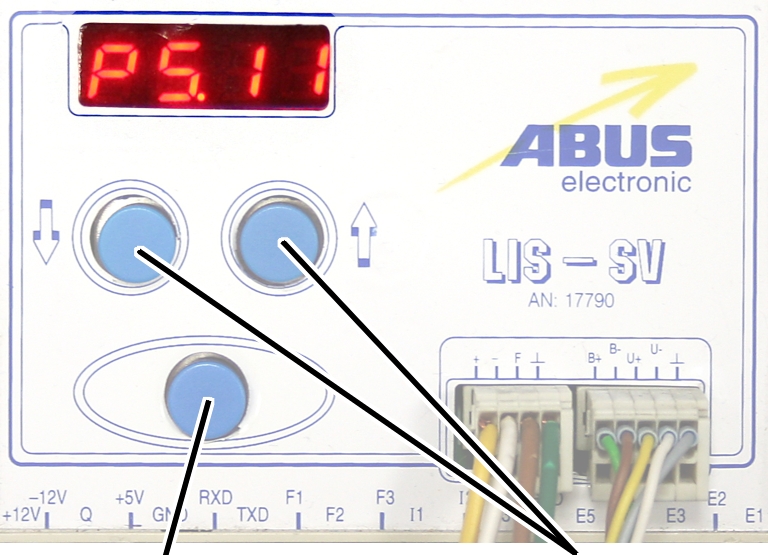
 Select parameter 5.10.
Press ENTER.
● The
'ABULiner' parameter level is activated.
● Parameter
5.11 is displayed.
Exiting the
'ABULiner' parameter level
|
|
|
Enter
button |
Arrow
buttons |
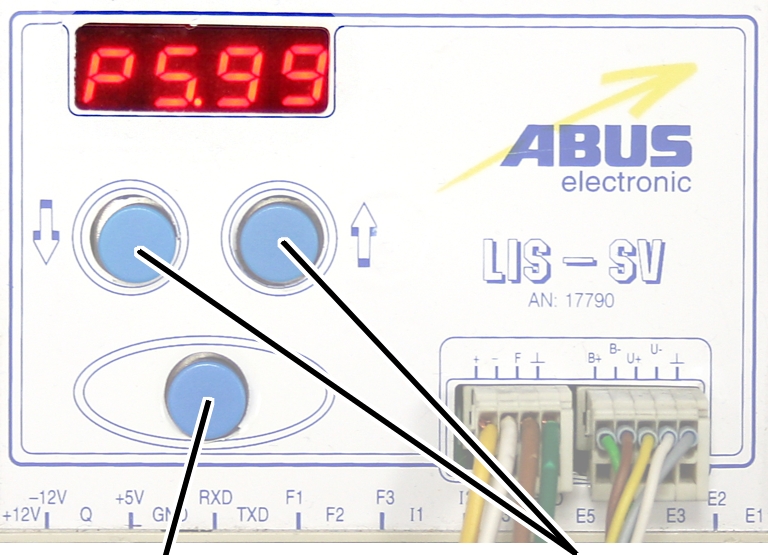
Select parameter 5.99.
Press ENTER.
● The
previous parameter level is reactivated.
● Parameter
5.10 is displayed.
The LIS-SV is automatically activated for the ABULiner if a
value is entered for the parameter 5.11.
In the ABULiner mode (a value is set for parameter 5.11):
─ The
LIS-SV can monitor the total load for a maximum of two wire rope hoists.
─ Input F3
(normally used for measuring the load of wire rope hoist 3) now serves in
monitoring the current rotational frequency of the hoist motor.
─ A value
can be entered for parameter 3.0 (maximum load capacity of wire rope hoist 3).
If a value is entered for this, parameter 5.11 cannot be set.
─ This
interlocking thus excludes an incorrect setting.
─ The
load-controlled switching point at output TxD of the LIS-SV cannot be used.
─
Parameter 4.5 (setting for load-controlled switching point) is not available.
In the normal mode (no value is set for parameter 5.11):
─
Operation of the ABULiner Lifting/Lowering unit is not possible.
─ The
LIS-SV can monitor the total load for up to three wire rope hoists.
─ Input F3
serves in measuring the load of a third wire rope hoist.
─ A value
can be entered for parameter 5.11 (gear ratio). If a value is entered for this,
parameter 3.0 cannot be set.
─ This
interlocking thus excludes an incorrect setting.
─ The
load-controlled switching point at output TxD of the LIS-SV can be used.
─
Parameter 4.5 (setting for load-controlled switching point) can be used.
The LIS-SV uses the signal of the encoder and the gear ratio
of the hoisting gear to calculate the hook travel distance, the maximum distance
in the limit switch range and the current rotational frequency of the hoist
motor. The gear ratio must be set on the machine.
|
|
|
Cable
speed |
|
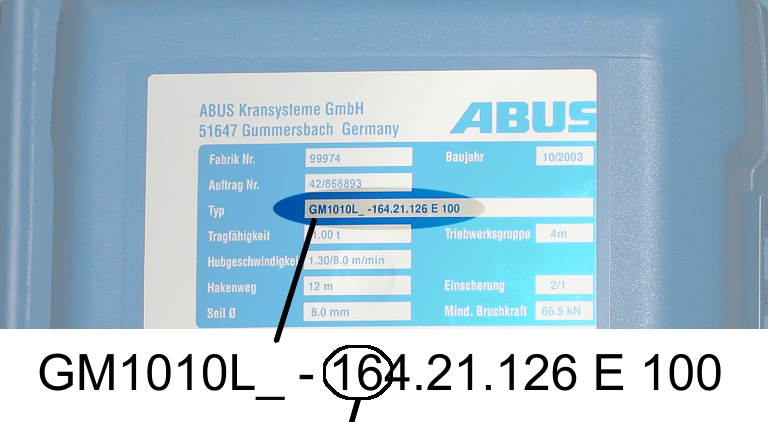
Read off the type
designation at the type plate of the wire rope hoist.
Read off the cable
speed.
From this table, select
the gear ratio that matches the cable speed.
|
|
Cable
speed |
|
Hoist motor GM |
32 m/min at 50 Hz
38 m/min at 60
Hz |
25 m/min at 50 Hz
30 m/min at 60
Hz |
20 m/min at 50 Hz
24 m/min at 60
Hz |
16 m/min at 50 Hz
19 m/min at 60
Hz |
|
800.4 |
50.01 |
63.49 |
77.77 |
98.16 |
|
800.5 |
47.03 |
60.04 |
74.66 |
95.03 |
|
1000.6 |
54.43 |
68.91 |
84.00 |
105.1 |
|
1000.7 |
54.60 |
68.06 |
81.45 |
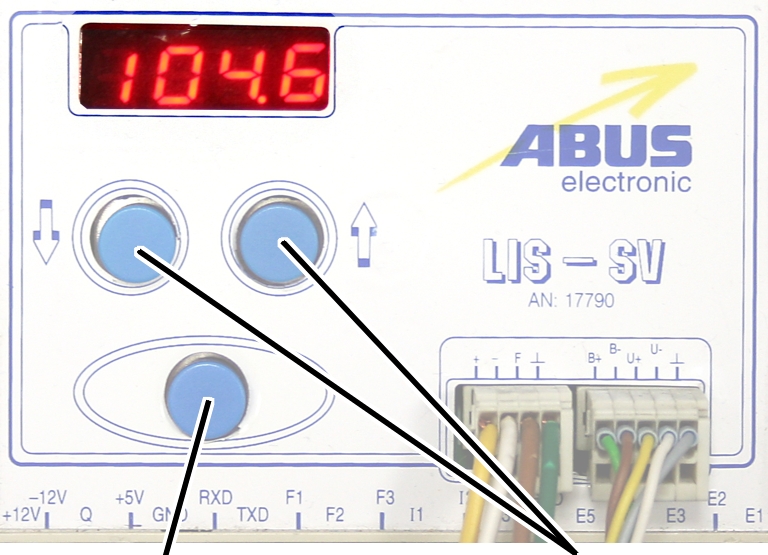
104.6 |
|
2000.3 |
58.22 |
74.23 |
91.19 |
118.4 |
|
3000.4 |
73.61 |
93.92 |
118.4 |
152.9 |
|
5000.3 |
85.14 |
109.3 |
132.8 |
169.0 |
|
5000.4 |
80.20 |
104.9 |
127.7 |
160.6 |
|
6000.3 |
94.69 |
118.5 |
149.6 |
182.7 |
|
7000.1 |
118.0 |
148.3 |
182.6 |
232.0 |
|
|
|
|
|
|
Table: Gear ratios (numerical values) depending on
hoist motor (lines) and cable speeds (columns) at 50 and 60 Hz.
|
|
|
Enter
button |
Arrow
buttons |
Move the load hook out of
the limit switch range (up or down).
During parameter setting, the load hook must not be within the
limit switch range.
Select parameter 5.11.
Press ENTER.
● The set
value is displayed.
If the value is 0.00, the function is deactivated.
● Hold ENTER
pressed.
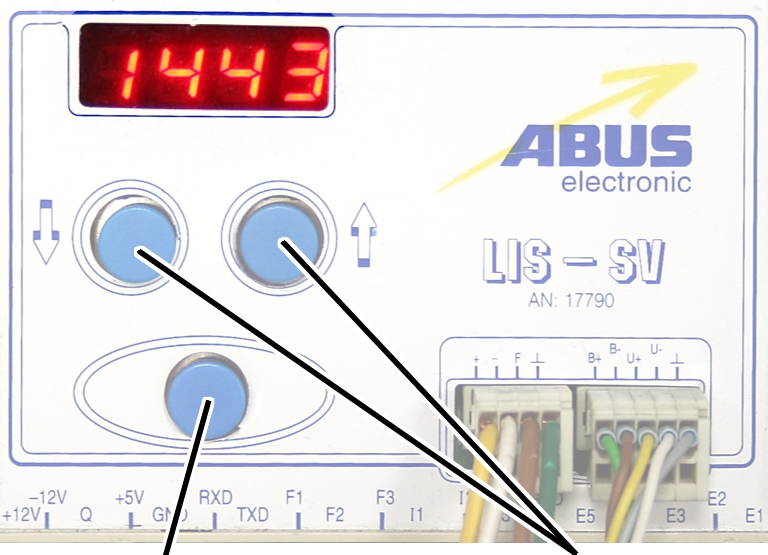
● CODE is
displayed.
Hold ENTER pressed.
|
|
|
Enter
button |
Arrow
buttons |
Enter the code 1443.
Press ENTER briefly.
|
|
|
Enter
button |
Arrow
buttons |
Set the value from the
table.
If the display ‘0.00’ cannot be changed, a value is set in
parameter 3.0. In this case, set the value to zero first.
Press ENTER briefly.
Wwwantarvasna Rape Storiescom Patched !free! May 2026
Successful campaigns, like Breast Cancer Awareness Month or the Stay Loud movement, focus on early detection and red flags. They equip the public with the knowledge to intervene before a situation becomes a tragedy.
We often hear numbers—"1 in 4 women" or "millions affected"—but figures can feel abstract. A story puts a face to the data, making it impossible to ignore the human cost. wwwantarvasna rape storiescom patched
For someone currently in the middle of a crisis, a survivor’s story serves as a "proof of life." It demonstrates that survival is possible and provides a visual of what the other side of the struggle looks like. How Awareness Campaigns Bridge the Gap Successful campaigns, like Breast Cancer Awareness Month or
From Silence to Strength: The Impact of Survivor Stories and Awareness Campaigns A story puts a face to the data,
The rise of social media has fundamentally changed how survivor stories and awareness campaigns interact. The movement is perhaps the most prominent example of how a simple phrase can spark a global reckoning. Digital platforms allow stories to bypass traditional gatekeepers, reaching a global audience in seconds.
Powerful storytelling often reaches the ears of lawmakers. History has shown that when survivors testify and campaigns gain momentum, it leads to tangible legal shifts, such as the Violence Against Women Act (VAWA) or improved workplace harassment laws.
Awareness campaigns direct people to the tools they need—hotlines, shelters, support groups, and legal aid. They bridge the gap between a person in need and the help available to them. The Digital Revolution: Going Viral for Good
Only for auxiliary fans
The auxiliary fan of the hoist motor continues to run for
several minutes after the lifting or lowering. This ensures that the hoist motor
is adequately cooled even at slow lifting speeds. The run-on time can be
adjusted.
|
|
|
Enter
button |
Arrow
buttons |
Move the load hook out of
the limit switch range (up or down).
During parameter setting, the load hook must not be within the
limit switch range.
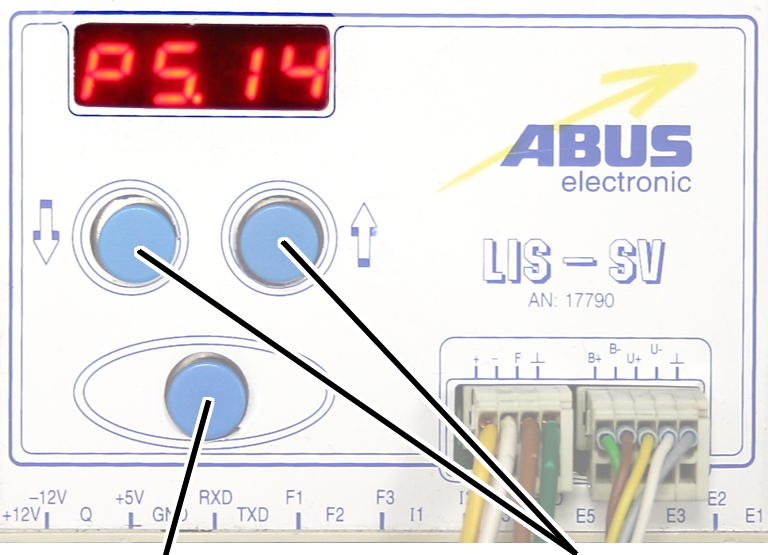
Select parameter 5.14.
Press ENTER.
● The set
value is displayed.
|
|
|
Enter
button |
|
Set the value to between 3
and 10 minutes using the arrow buttons.
Press ENTER.